
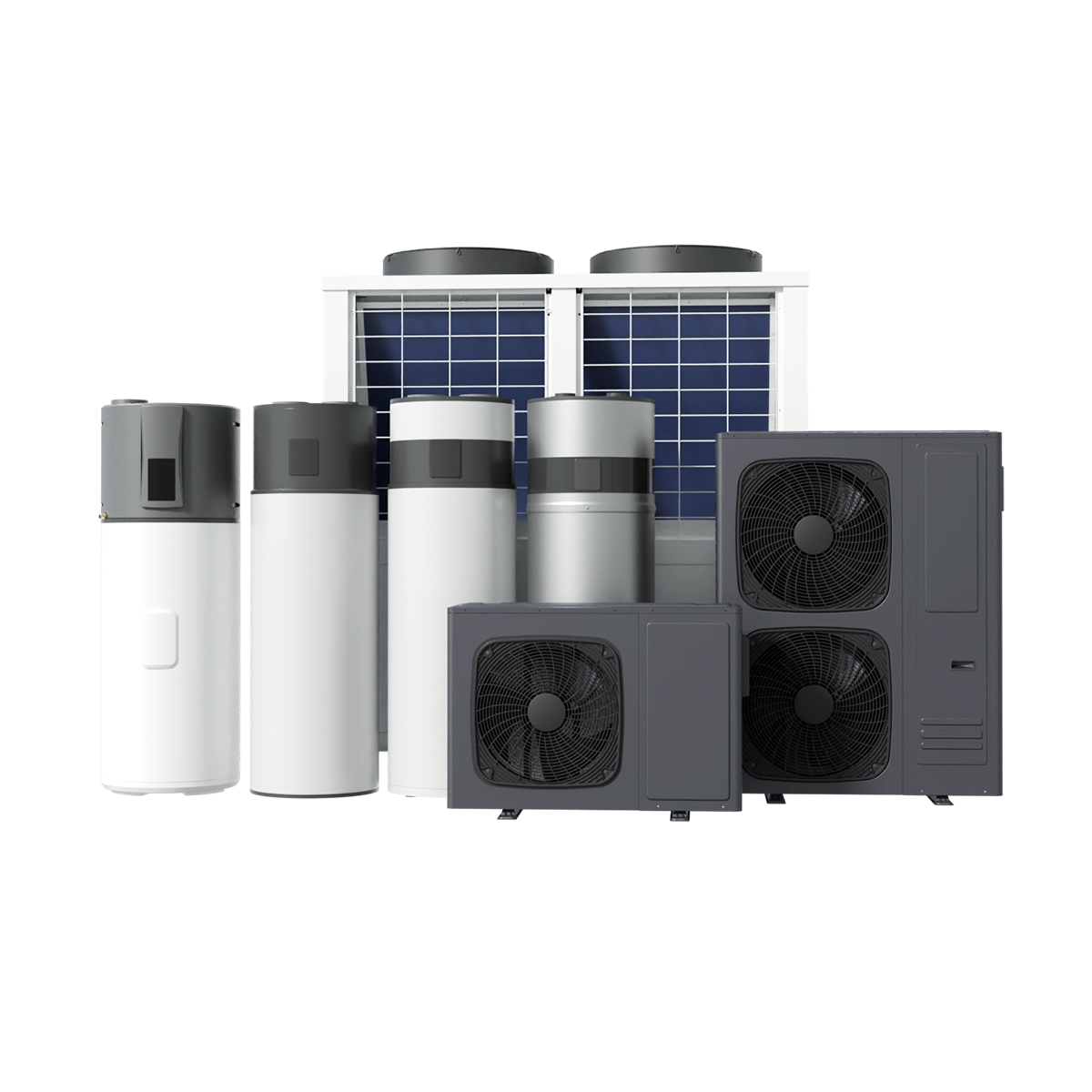

One machine. Three reports. And almost every week, someone sends the wrong one.
Here is the pattern we see most often on the export side: a customer asks for “the ErP report”, the lab delivers an EN 14825 seasonal efficiency test, and the file gets forwarded. Two weeks later it comes back rejected — because the Australian rebate model actually needed an EN 14511 performance map, and a seasonal report cannot produce one.
This article separates the three documents by purpose, legal basis, and — most importantly — what each one cannot do. The EN 14825 vs EN 14511 distinction is the one buyers get wrong first, so we start there. If you buy, sell, or specify commercial heat pump water heaters, this is the checklist that saves you a resubmission.
The one-line version: seasonal efficiency → EN 14825:2022. Performance map → EN 14511-2/-3:2022. Market listing → EPREL. Three jobs, three documents, no substitutes.
1. EN 14825 vs EN 14511 vs EPREL: what each document actually does
| Document | Legal / standard basis | The question it answers | Who needs it |
| ① ErP / seasonal efficiency report | EN 14825:2022 (SCOP / ηs / part load) + Reg. (EU) 813/2013 Annex II + Reg. (EU) 811/2013 Annex II | Over a whole heating season, how much energy does this unit use? Does it clear the EU minimum? Which label class? | EU CE technical file, energy label calculation, EPREL registration |
| ② EN 14511 performance map report | EN 14511-2:2022 (test conditions) + EN 14511-3:2022 (test methods); in Australia also AS/NZS 4234:2021 | At this air temperature and this water temperature — how many kW, what COP, right now? | VEU / ESS rebate modelling (AU), system design and equipment selection, controller performance maps |
| ③ EPREL registration & label | Reg. (EU) 2017/1369; ESPR (EU) 2024/1781, Art. 79 | Is there a verifiable record for this model in the EU database? | Customs inspection, Amazon and other marketplaces, distributors |
Note the difference in tense. Document ① is an average over a season. Document ② is a snapshot at a single operating point. Document ③ is not a test at all — it is a registry entry.
2. The trap: an ErP report is not an EN 14511 report
This is the single most expensive misunderstanding in the category, and it is still being repeated in supplier documentation.
An Ecodesign (ErP) report cannot be used as an EN 14511 report. A part-load seasonal performance report produced to EN 14825:2022 cannot be used to build a performance map.
The reason is structural, not bureaucratic. A seasonal report gives you weighted results at a handful of bin points — a few numbers, already averaged for a reference climate. A performance map requires a two-dimensional surface covering the full envelope of air temperature and water temperature. You cannot reconstruct a surface from four weighted points. Anyone who hands you a seasonal report and calls it a performance map is handing you an interpolation, not a test.
3. SCOP and ηs are not the same number — and the regulation only caps one of them
Many people read the figure on the label as if it were a SCOP threshold. It isn’t. The regulated quantity is ηs (seasonal space heating energy efficiency), and the relationship is:
ηs = SCOP ÷ CC
(then corrected for temperature control, and for ground-water pump power on water-to-water and brine-to-water units)
CC is fixed at 2.5 by regulation, representing an EU average power generation efficiency of roughly 40%, per Directive 2012/27/EU. This is why ηs values above 100% are completely normal: ηs is a primary energy metric, not a coefficient of performance. Seeing 140% on a datasheet is not a calculation error.
| Parameter | Value / clause | Note |
| Conversion factor CC | 2.5 (813/2013, ref. Dir. 2012/27/EU) | ηs = SCOP ÷ 2.5, then corrected |
| Minimum ηs | 110% (since 2017-09-26); 125% for low-temperature heat pumps (since 2015-09-15) | Reg. 813/2013 Annex II; previously 100% / 115% |
| Minimum SCOP | Not set by regulation | Do not judge compliance on SCOP directly — convert to ηs and apply corrections |
| Efficiency class (55 °C) | A+++ ≥150%, A++ ≥125%, A+ ≥98%, A ≥90% | Reg. 811/2013 Annex II; low-temperature units use a separate scale, boundaries do not overlap |
| Climate zone | Average / colder / warmer = Strasbourg / Helsinki / Athens | Compliance is verified in the average climate only |
“The framework directives were repealed — so the label thresholds are gone, right?”
No. And this misunderstanding keeps circulating.
Reg. 813/2013 was made under Directive 2009/125/EC, which was repealed by ESPR (EU) 2024/1781 on 2024-07-18. Reg. 811/2013 was made under Directive 2010/30/EU, repealed by Reg. (EU) 2017/1369 on 2017-07-31. The parent directives are gone; the two regulations themselves remain in force, and the classes and minimum values are still enforced exactly as written.
A revision is in preparation (PEF moving from 2.5 to 1.9, scope extended up to 1 MW, among other changes), but as of now it has not been published in the Official Journal. Do not rewrite your label copy before it is.
4. Australia: twelve test points, and a missing high-temperature point costs you ~40%
For Australian VEU / ESS commercial heat pump water heater modelling, the starting matrix is fixed. Its value is not “more data points” — it is that it tells you which points you cannot skip.
| Refrigerant | Water inlet (°C) | Air dry-bulb / wet-bulb (°C) | Points |
| R-290 | 10 / 50 / 70 | 2/1, 7/6, 19/15, 38/25 | 12 |
| CO2 (R744) | 10 / 30 / 50 | 2/1, 7/6, 19/15, 38/25 | 12 |
A real example makes the stakes obvious. Take an R-290 unit rated 14.5 kW at 7 °C air, 50 °C water in. If the report has no high-temperature point, the model can only interpolate linearly from 10 °C to 70 °C water and will output 8.6 kW — an underestimate of roughly 40%. The same unit, at constant 50 °C water in, has a COP of 3.6 at 19 °C air and 4.5 at 30 °C air; miss the 30 °C point and every warm-weather hour gets modelled at 3.6.
Under-modelled capacity means overstated running hours, overstated energy savings, and a rebate application that fails at review.
5. The four reasons reports get rejected
- The existing report’s maximum water inlet temperature is below the stated operating limit. Supplement with a re-test. Do not assume the existing data covers the range.
- An ErP report was submitted as an EN 14511 report. Check the test specification first. A part-load seasonal report cannot build a map.
- The lab says a condition “can’t be tested”. In most cases the unit was configured as fixed-temperature-rise with a fixed water temperature. Write the test condition and the flow control strategy into the test plan together.
- The model number on the report does not match. Lock the final model designation before issuing the report, not after.
Reference chain for Australian submissions: EN 14511-2:2022 / EN 14511-3:2022 (test) · AS/NZS 4234:2021 (energy consumption calculation) · ESC C/21/35298 V2.1 (commercial and industrial air source heat pump water heater product application guide) · IPART IHEAB V1.2 (water heater product acceptance guide).
6. Three-step self-check you can run today
Step 1 — Check the version. Go through every test report, CE technical file (DoC), and EPREL record reference. EN 14511-1~4:2018 and EN 14825:2018 have both been withdrawn; all references should now point to the 2022 editions. EN 14825:2022/prA1 is still under approval, and EN 14511-2:2022/FprA1 has a target publication date of 2027-01-20 — until then, the 2022 editions remain the valid ones.
Step 2 — Check the report type. Ask one question: who is this report for?
- EU label calculation → EN 14825 seasonal report
- Australian modelling or equipment selection → EN 14511 performance map report
- Customs or marketplace listing → EPREL registration number and label QR code
These three are not interchangeable, in any direction.
Step 3 — Check model consistency. Four names must line up: the report model, the EPREL registration model, the shipping nameplate model, and the Australian STC listing model. Per the Clean Energy Regulator register, air source heat pump water heaters ≤425 L are assessed under AS/NZS 2712:2007, with STCs calculated on a 10-year deemed basis; installation must match the register exactly, and any hardware or component change causes forfeiture. Register model names frequently differ from marketing names — verify before you quote.
FAQ
Can an ErP (EN 14825) report be used as an EN 14511 report? No. A seasonal report contains weighted results at a few bin points; a performance map requires a two-dimensional surface across the full air and water temperature envelope. The two cannot be converted into each other.
Is SCOP the same as ηs? No. ηs = SCOP ÷ 2.5 (with corrections for temperature control and ground-water pump power). The regulation sets a minimum for ηs, not for SCOP.
Can an ηs value exceed 100%?
Yes, and it normally does. ηs is a primary energy metric, so values above 100% are expected rather than indicative of an error.
Are EN 14511:2018 reports still acceptable? No. The 2018 editions of EN 14511-1~4 and EN 14825 have been withdrawn and replaced by the 2022 editions.
Why do Australian submissions need twelve test points? Because rebate modelling integrates performance across the full operating envelope. A missing high-temperature point can cause a ~40% underestimate of capacity at design conditions.
Do I need EPREL registration to sell in the EU? For energy-related products in scope, yes — registration is required before placing the model on the market, and the label and product information sheet are derived from it.
Before you request a quote
Ask your supplier three questions:
- Which edition of EN 14511 and EN 14825 were the reports issued against — 2018 or 2022?
- Does the report model number match the EPREL registration, the nameplate, and the STC listing?
If any of the three comes back vague, the report will not survive review — no matter how good the machine is.
Linuo Ritter manufactures commercial air-to-water heat pump water heaters on R-290, with EN 14825:2022 seasonal reports, full EN 14511 performance maps, and EPREL registration prepared as a single document set. Contact our engineering team for the model-specific test matrix.
